


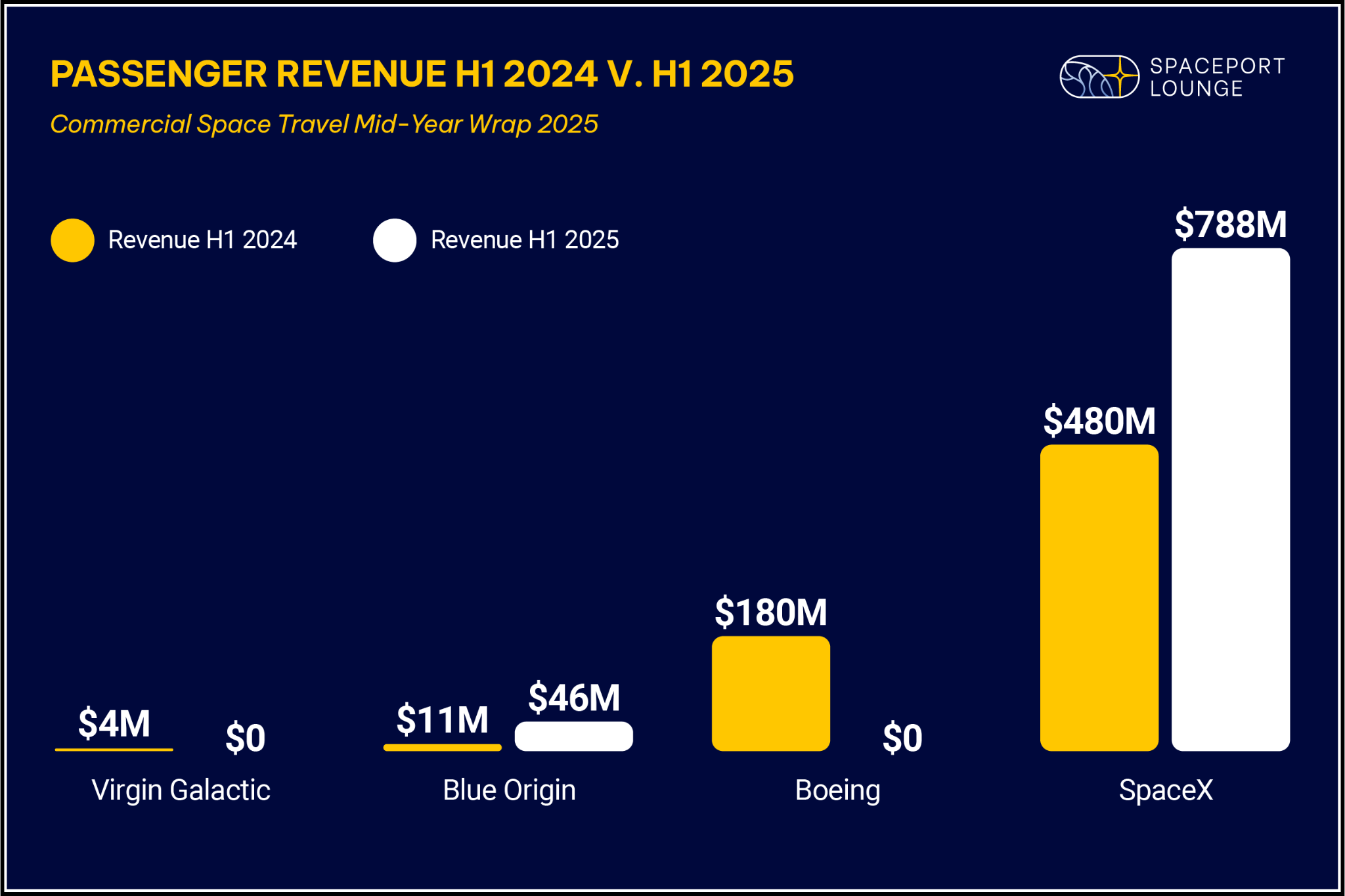
Passenger revenue in commercial space travel is surging year-over-year, but all of the gains are concentrated in just two companies. In the first half of 2025, SpaceX grew its already dominant orbital revenue base by $300 million, while Blue Origin quadrupled its suborbital passenger count after expanding its fleet. Together, they account for 100% of the sector’s commercial passenger revenue in the first half of 2025.
Industry growth came despite Boeing and Virgin Galactic recording no flights or passengers in the first half of 2025, widening the gap between active operators and those on pause.
Some of the most revealing insights in our mid-year wrap with the full picture in the charts below:
Two-thirds of SpaceX’s passenger revenue comes from outside NASA’s Commercial Crew Program providing revenue diversification.
An estimated one-third of Blue Origin passengers flew without paying themselves, as invited guests, grant recipients, or contest winners.
North America accounts for nearly 70% of all commercial space passengers. Learn how the rest of the world divides the remaining 30%.
SpaceX maintains a 50/50 gender balance; the full breakdown shows how other companies compare.
Blue Origin’s passengers averaged 55 years old over the past 12 months, with an age range from 21 to 85. See how this stacks up across all operators in the charts.
This report is based on publicly available information and independent analysis. Spaceport Lounge tracks shifts in commercial space travel, where analysis is scarce and inconsistent. The figures are not flawless, but they reveal essential trends in passenger segments, flight cadence, and revenue growth. Using careful modeling and our proprietary database, we create a reliable baseline that preserves the origins of the industry. Estimates and modeling are used for revenue figures in this report with revenue recognition timing based on mission launch dates.
H1 2024 vs. H1 2025 – Commercial Space Travel
Passenger Revenue
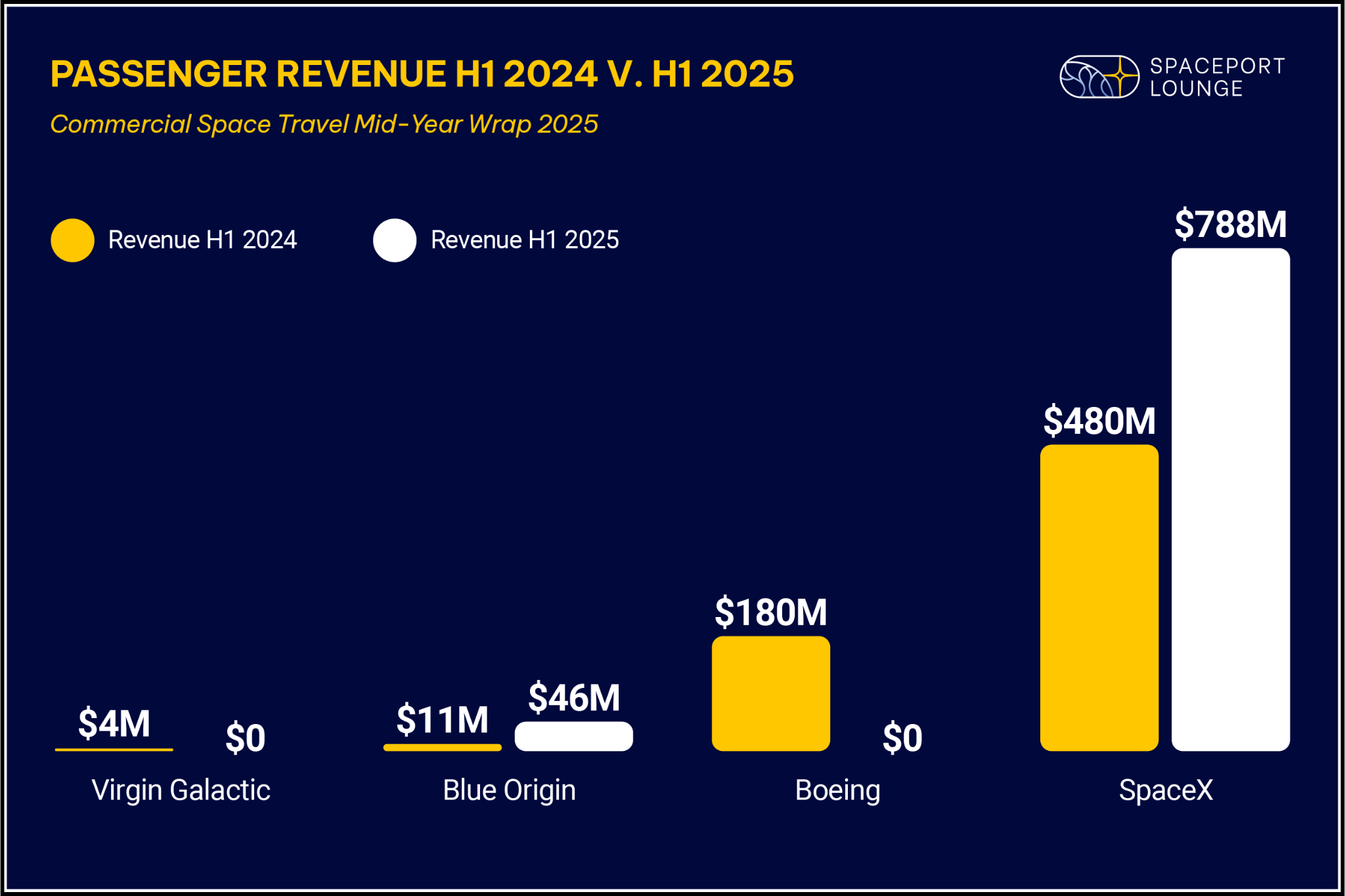
For estimated revenue, Blue Origin quadrupled suborbital revenue year-over-year after resuming flights in early 2024 and adding new hardware in Q4 2024, setting up for near-monthly missions in 2025. SpaceX grew 64% on a large base, adding $300 million to H1 revenue. Boeing and Virgin Galactic dropped to zero, widening the gap between active and idle operators. The results reflect both the narrowing field of active providers when others pause for retooling and the dominant role of orbital missions in overall revenue.
Total Passengers
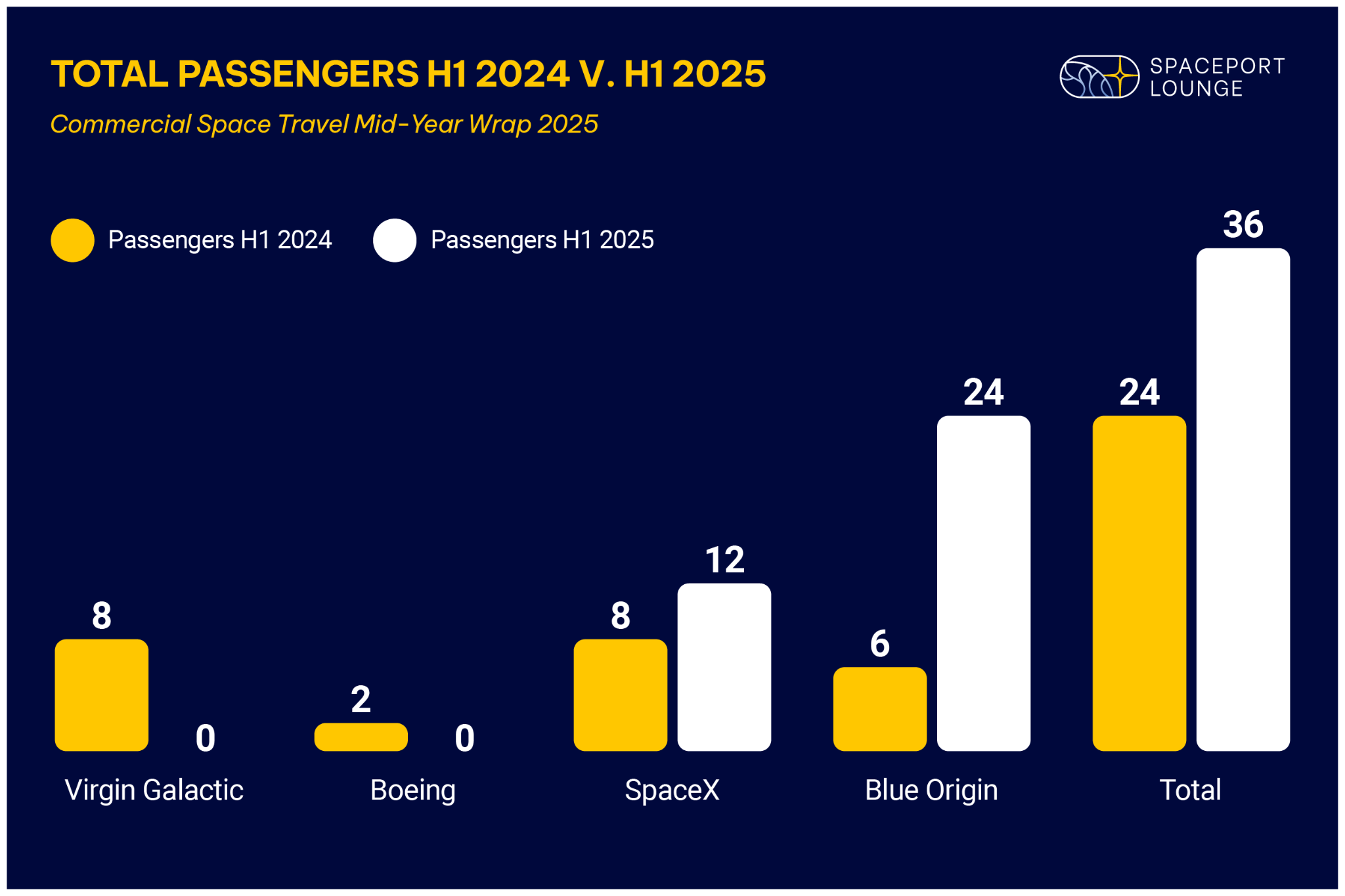
Passenger volume climbed from 24 in H1 2024 to 36 in H1 2025, a 50% increase. Blue Origin was the primary driver, quadrupling from six to 24 passengers after ramping suborbital flights. SpaceX also expanded, growing from eight to 12 passengers. Virgin Galactic and Boeing recorded no passengers in 2025 after modest activity the prior year. The gains highlight how both players benefited from investments in fleet expansion.
Total Missions
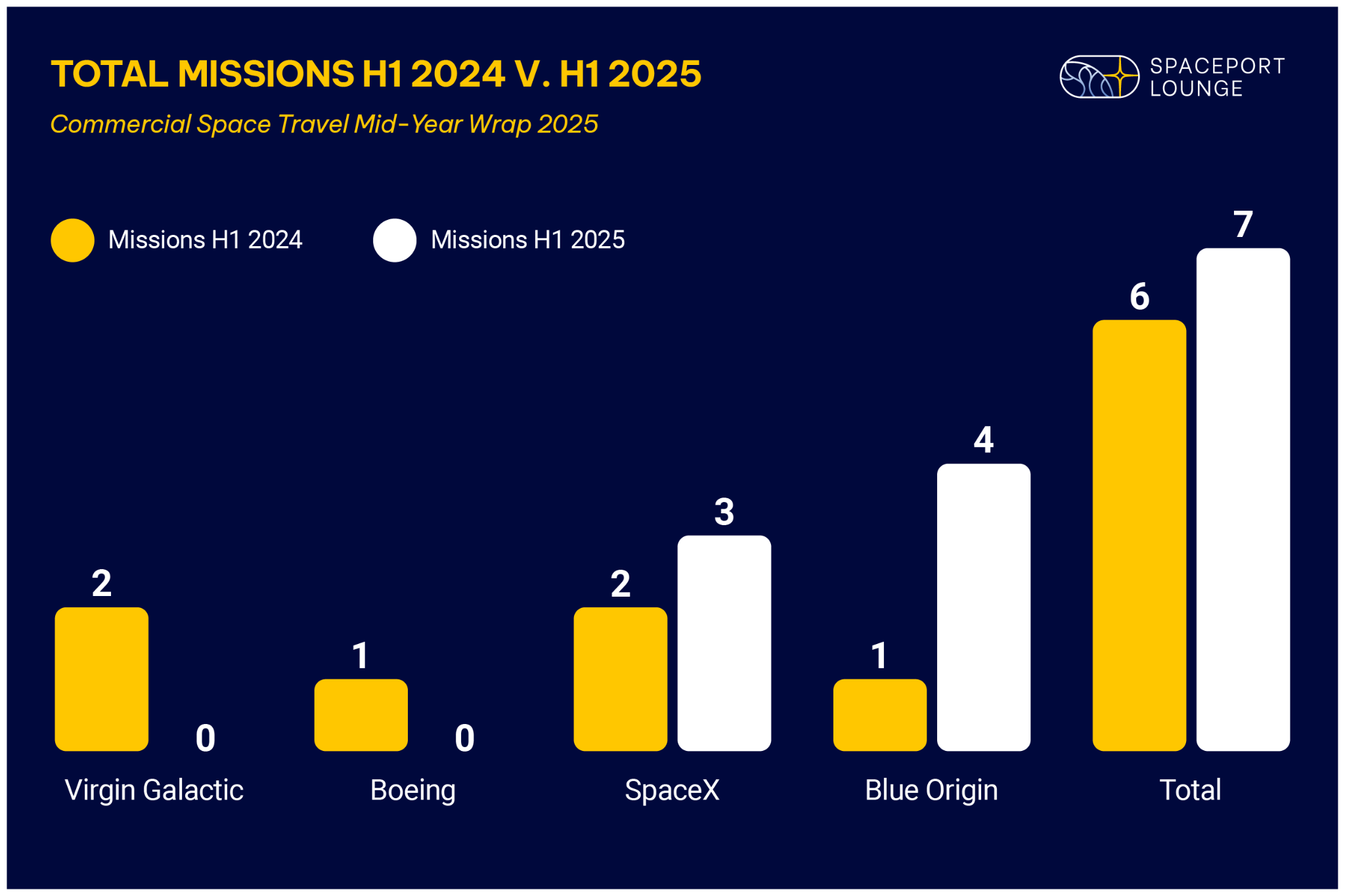
Commercial passenger missions rose from six in H1 2024 to seven in H1 2025. Blue Origin increased its cadence from one to four missions, and SpaceX from two to three. Virgin Galactic and Boeing had no launches in the period. The modest net gain reflects the offsetting effect of Virgin Galactic’s pause and Boeing’s slow ramp-up.
Trailing 12 Months July 2024-June 2025
Revenue by Company
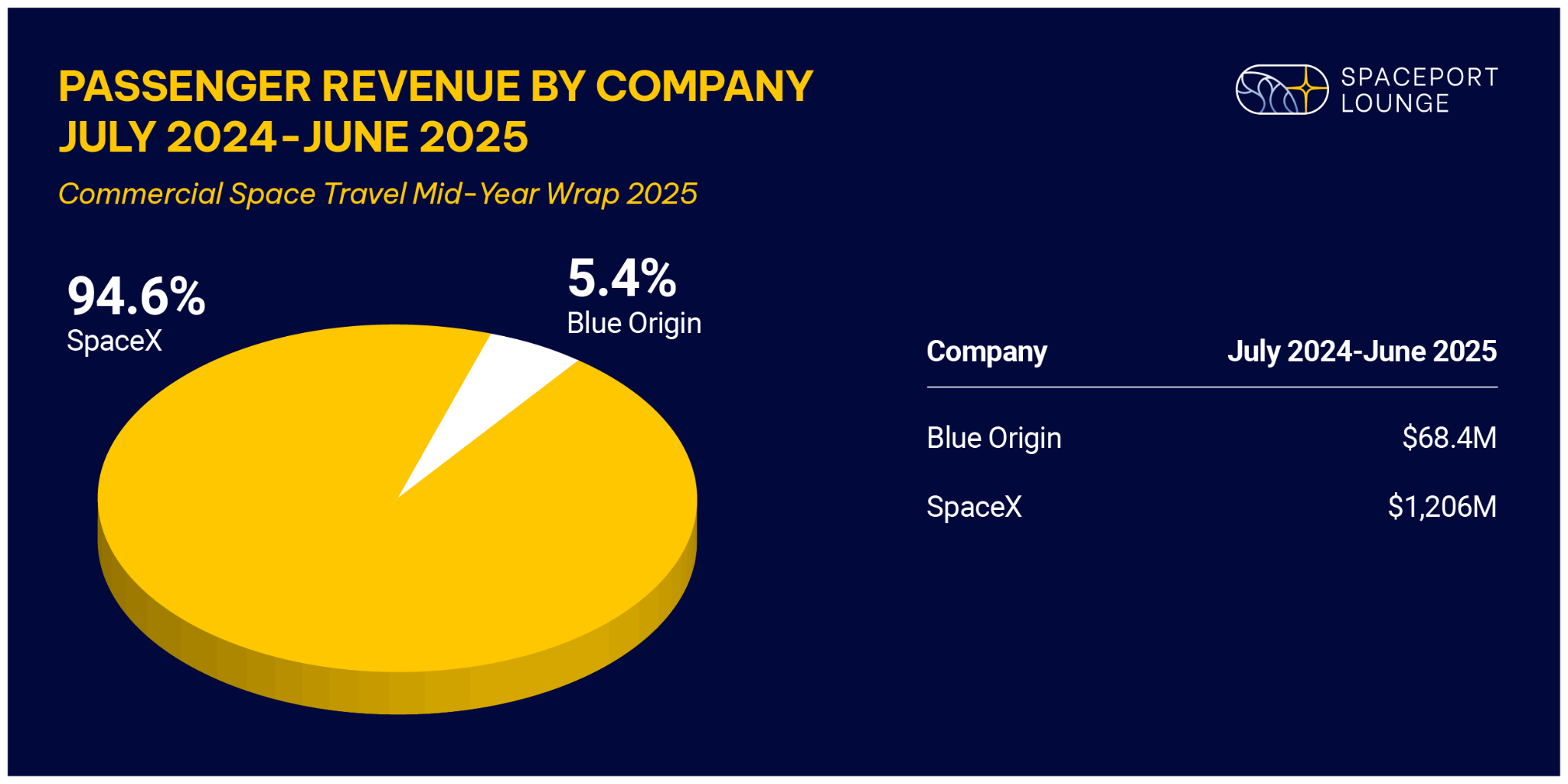
For estimated revenue, SpaceX captured 94.6% of all commercial passenger revenue over the period ($1.206B), with Blue Origin at 5.4% ($68.4M). The split underscores the revenue power of orbital flights and SpaceX’s market control. No other operator recorded passenger-derived revenue during the past 12 months.
Suborbital Passenger Revenue
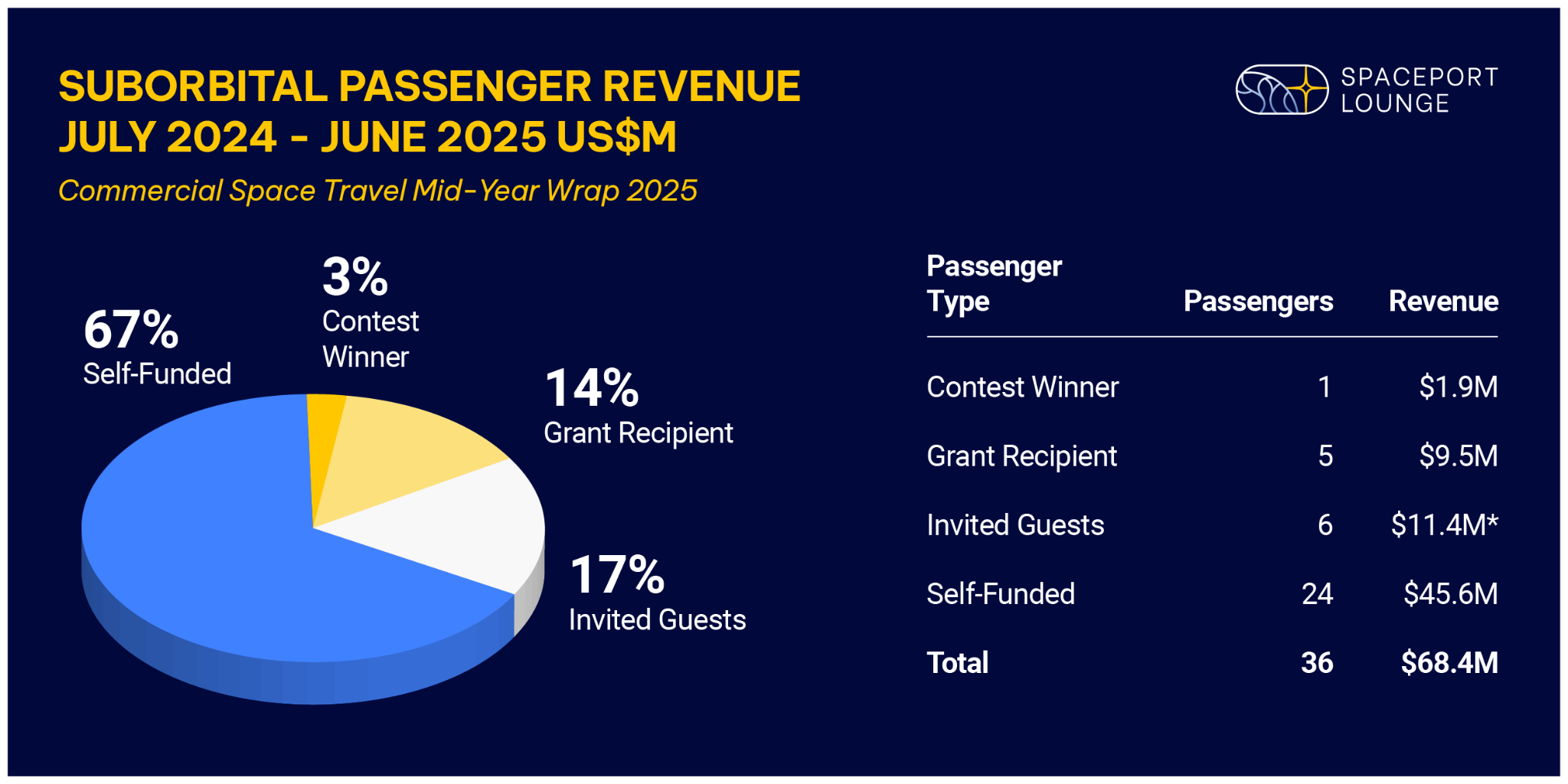
Only Blue Origin flew suborbital passengers during the period, generating an estimated $1.9M per seat. SPL infers that a portion of these travelers flew on a complimentary basis as Blue Origin guests. Some high-profile celebrities, along with STEM leaders, former astronauts, and other aspiring spacefarers, were likely invited for promotional or educational purposes. Others received seats through independent grants or contests, (Blue Origin does not offer grant or contest programs). Spaceport Lounge will share further insights on suborbital passenger segmentation in an upcoming report.
Orbital Passenger Revenue
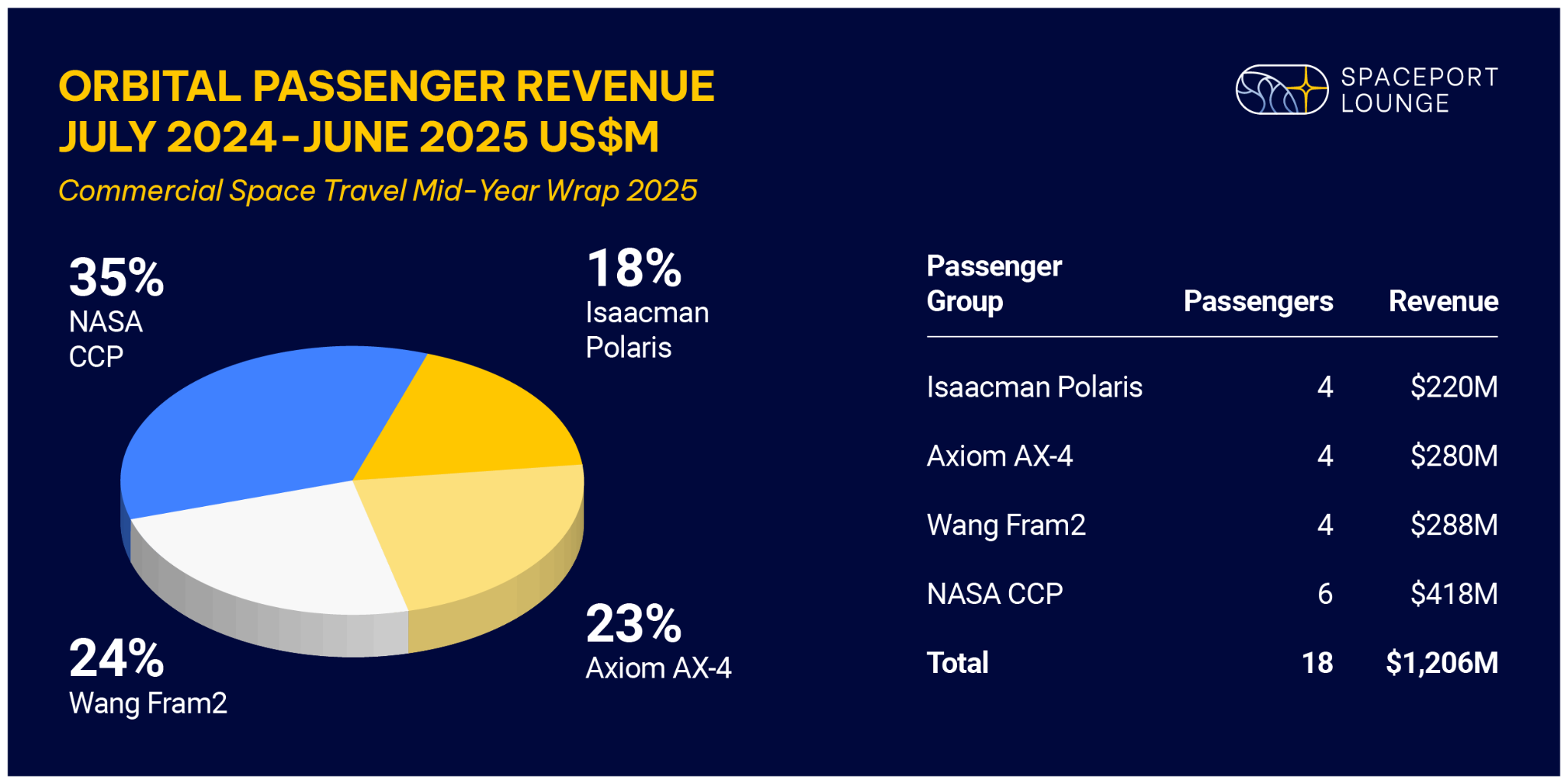
For estimated orbital revenue, SpaceX maintained a clean sweep of the $1.2B orbital segment, supported by revenue streams beyond NASA contracts. Billionaire-led private missions, Axiom’s charter purchases, and NASA CCP contracts provide multiple sources of demand. Boeing remains dependent on NASA’s Commercial Crew Program, with no private passengers to date.
Passengers by Region
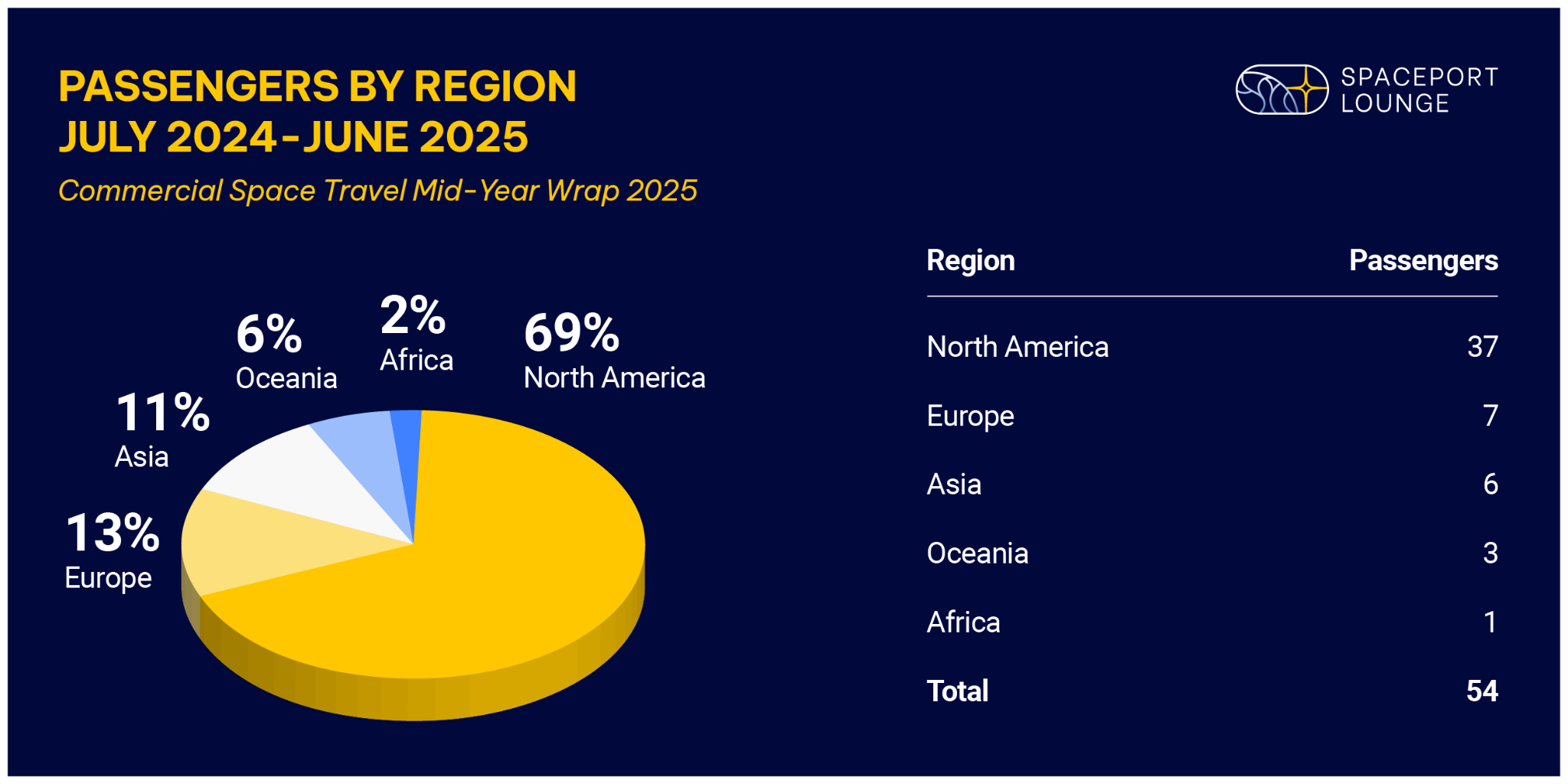
Nearly 70% of all commercial passengers originated from North America. The concentration reflects U.S. dominance in launch infrastructure and legacy positioning from the original space race.
Gender and Age by Company
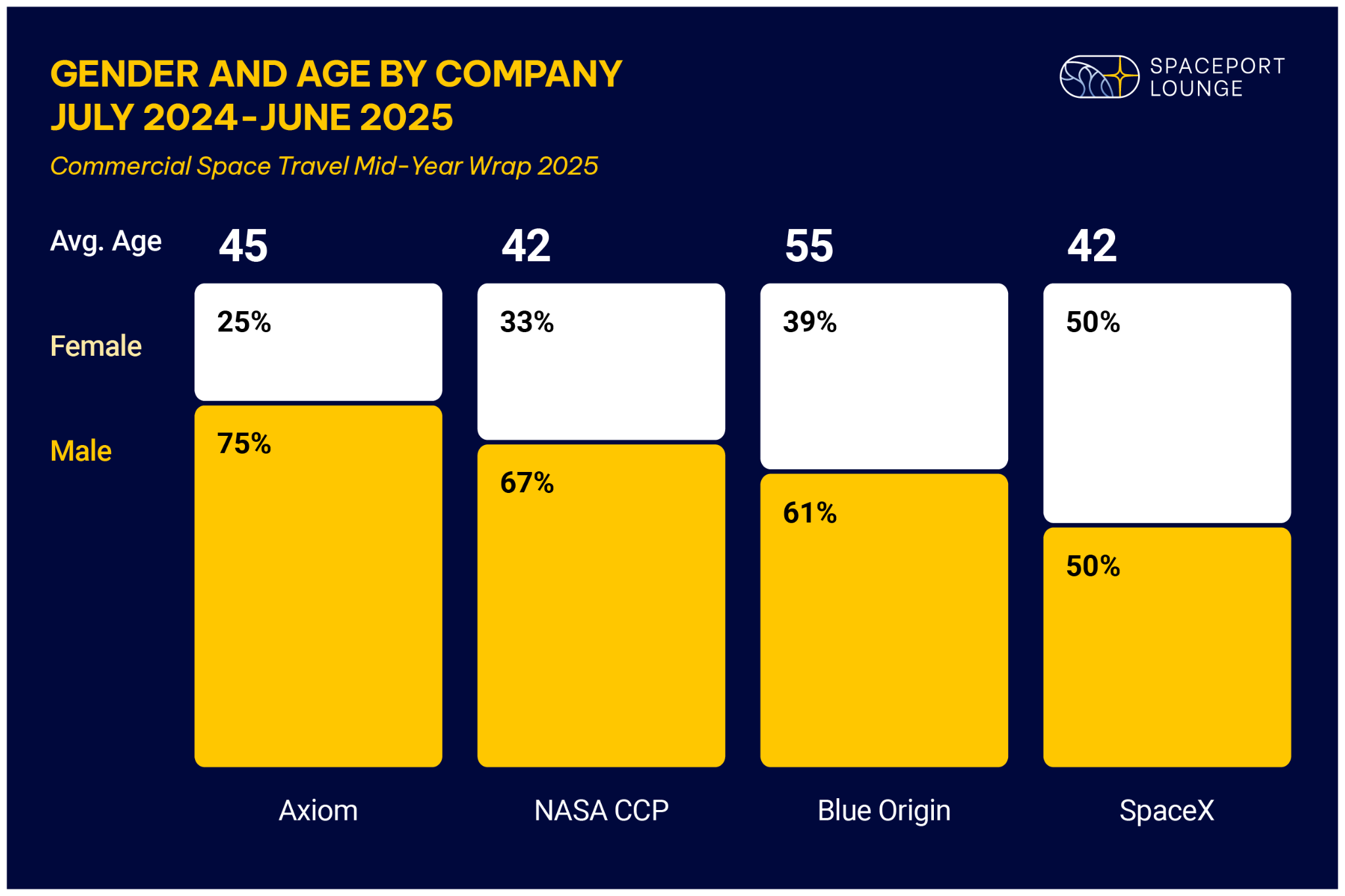
NASA CCP and Axiom are broken out separately, as they control crew selection despite flying aboard SpaceX vehicles. SpaceX has consistently flown equal numbers of male and female passengers. Blue Origin skews older, reflecting the lower physical demands of suborbital travel. Its passengers average 55 years old, with ages ranging from 21 to 85 over the past 12 months.
Why this data matters
Commercial space travel is still in its early stages and the patterns forming now will shape the industry for decades. The figures are not flawless, but they capture essential trends in passenger numbers, flight cadence, and revenue growth, along with the current concentration of market share. Documenting these developments in real time ensures we create a reliable baseline to preserve the industry’s origins.
Access the full picture
That work is sustained by our subscribers. Paid members receive complete access to all articles, archives, and data reports. Students and educators can request complimentary access. Our Space Travel Data Steward tier offers early dataset access and custom queries, enabling deeper collaboration in documenting this history.
At Spaceport Lounge, our mission is to humanize space travel and preserve its record as it unfolds. Thank you for reading and for helping build the definitive chronicle of the emerging commercial space travel era.
