


Commercial space travel continued its uneven expansion in 2025, with passenger volume growth driven almost entirely by Blue Origin’s 10-minute suborbital excursions. Passenger volume for longer, more complicated, and more consequential orbital missions was flat, with SpaceX claiming the entirety of that segment.
The number of active operators narrowed from four companies in 2024 to two in 2025, as Boeing and Virgin Galactic sat out the year in a retooling phase for their fleets.
The contraction reflects the reality of the scale, cost, and complexity of space passenger travel, which may appear to be booming to some but will in reality require several more years for U.S. players to return and expand, alongside likely future participation from China.
The growth brakes will face additional pressure in 2026, with suborbital travel potentially dropping from a high of 42 passengers in 2025 to zero. That outcome follows Blue Origin’s announcement that it will pause New Shepard flights and redirect resources toward NASA’s lunar flight program. The only current prospect for suborbital space travel this year is Virgin Galactic inaugurating its Delta fleet in the second half of the year.
The Moon has re-emerged as a central priority for U.S. space passenger travel, requiring a unification of resources even as the private space marketplace experienced a brief period of differentiated competition.
Orbital vs Suborbital Missions 2025
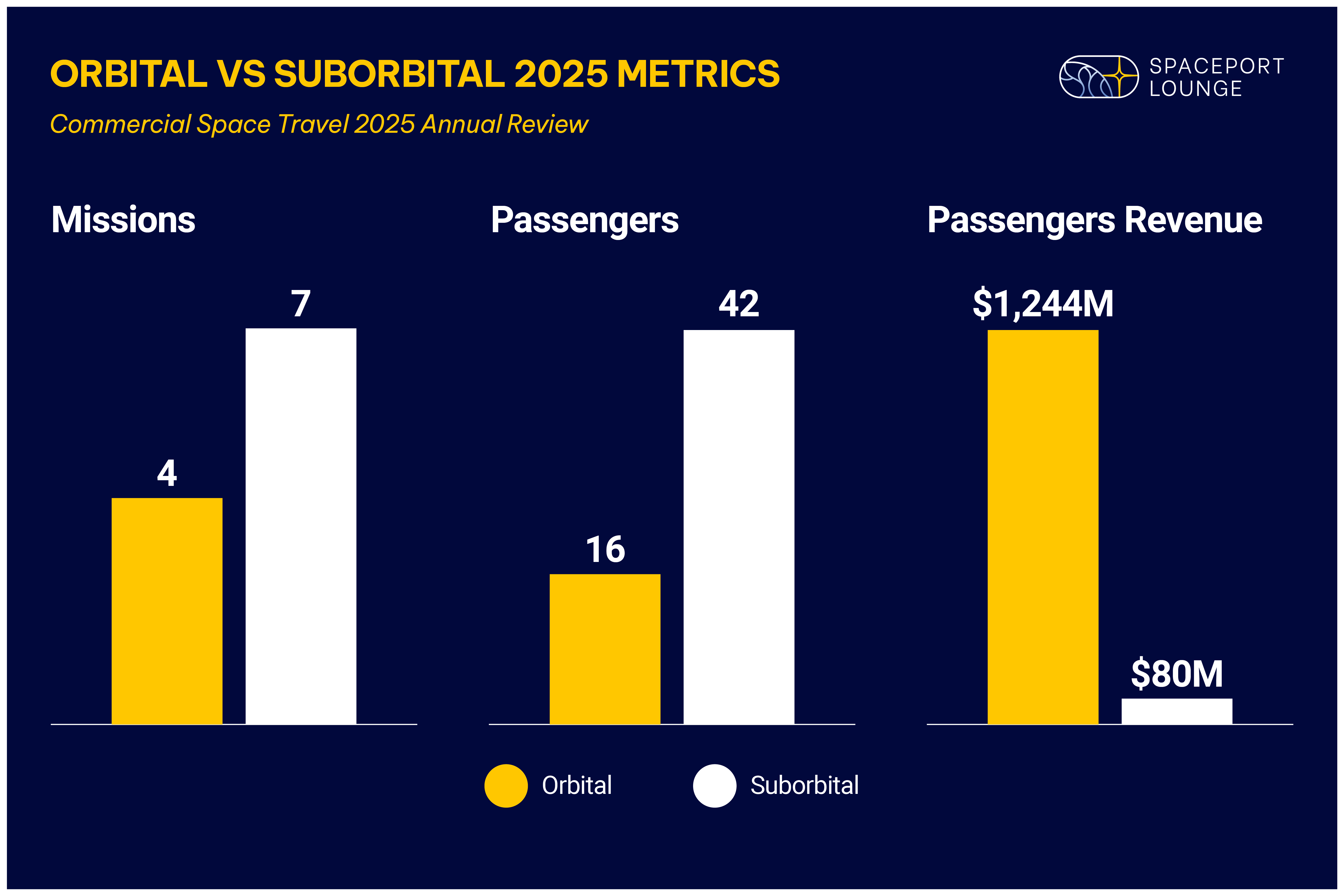
Suborbital missions consist of brief, roughly 10-minute flights that cross the Kármán line before returning to Earth, offering passengers a short experience of weightlessness. Orbital missions place crews into sustained low-Earth orbit for days or transport to the ISS for extended stays, requiring significantly more complex vehicles, training, and capital.
Suborbital missions outnumbered orbital flights nearly two to one in 2025 and carried more than twice as many passengers. Yet orbital missions generated over 90 percent of total passenger revenue. The contrast illustrates the structural divide within the market: suborbital travel scales people, while orbital travel scales revenue.
Passenger Volume: 2025 vs 2024
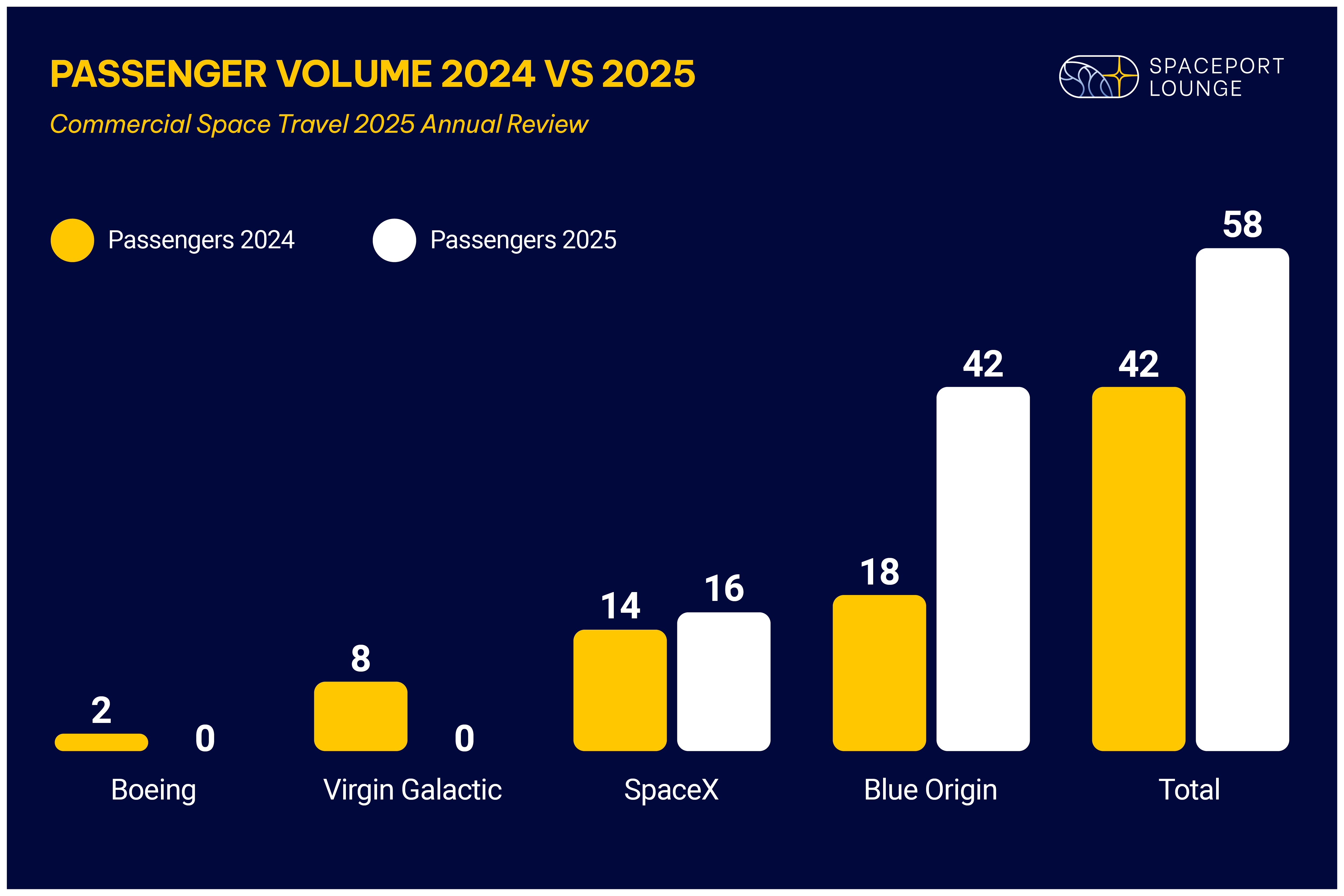
Total commercial space passenger volume increased from 42 in 2024 to 58 in 2025, a 38 percent gain. Blue Origin accounted for the majority of the increase, more than doubling its passenger count year over year as it approached a near-monthly launch cadence.
SpaceX added modest incremental growth, reflecting steady orbital demand from NASA’s Commercial Crew Program transporting crews to and from the ISS, alongside additional demand from Axiom’s chartering relationship and one mission, Fram2, funded by ultra-wealthy patron Chun Wang.
The absence of passengers from Boeing and Virgin Galactic underscores how sensitive industry totals remain to individual operator activity. Passenger growth in 2025 did not reflect broad participation, but rather a contraction in the number of active players.
Total Missions: 2024 vs 2025
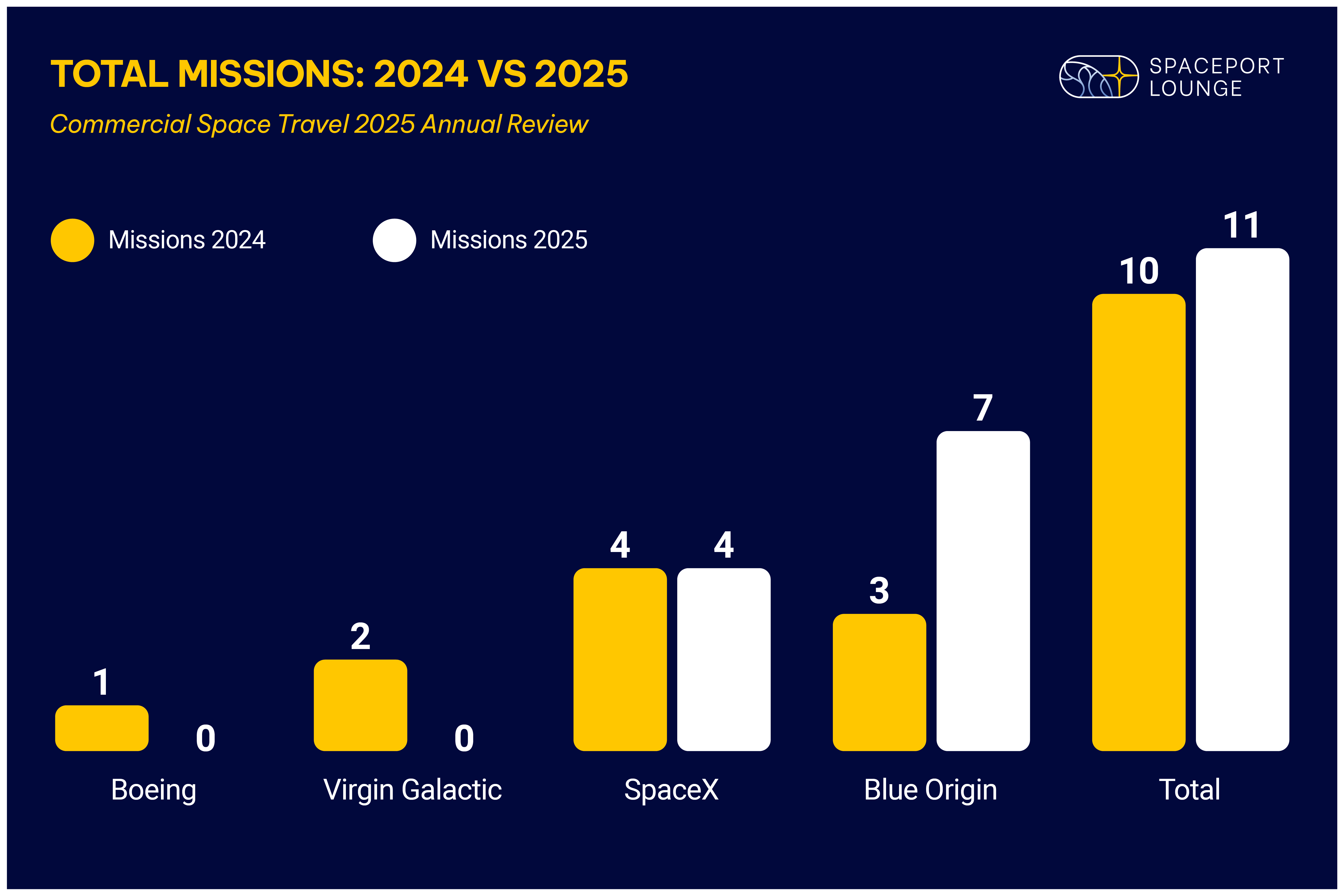
Commercial passenger missions increased slightly, from ten in 2024 to eleven in 2025. Blue Origin drove most of the change, expanding from three missions to seven as additional vehicles entered service. SpaceX held steady at four missions.
Passenger Revenue: 2024 vs 2025
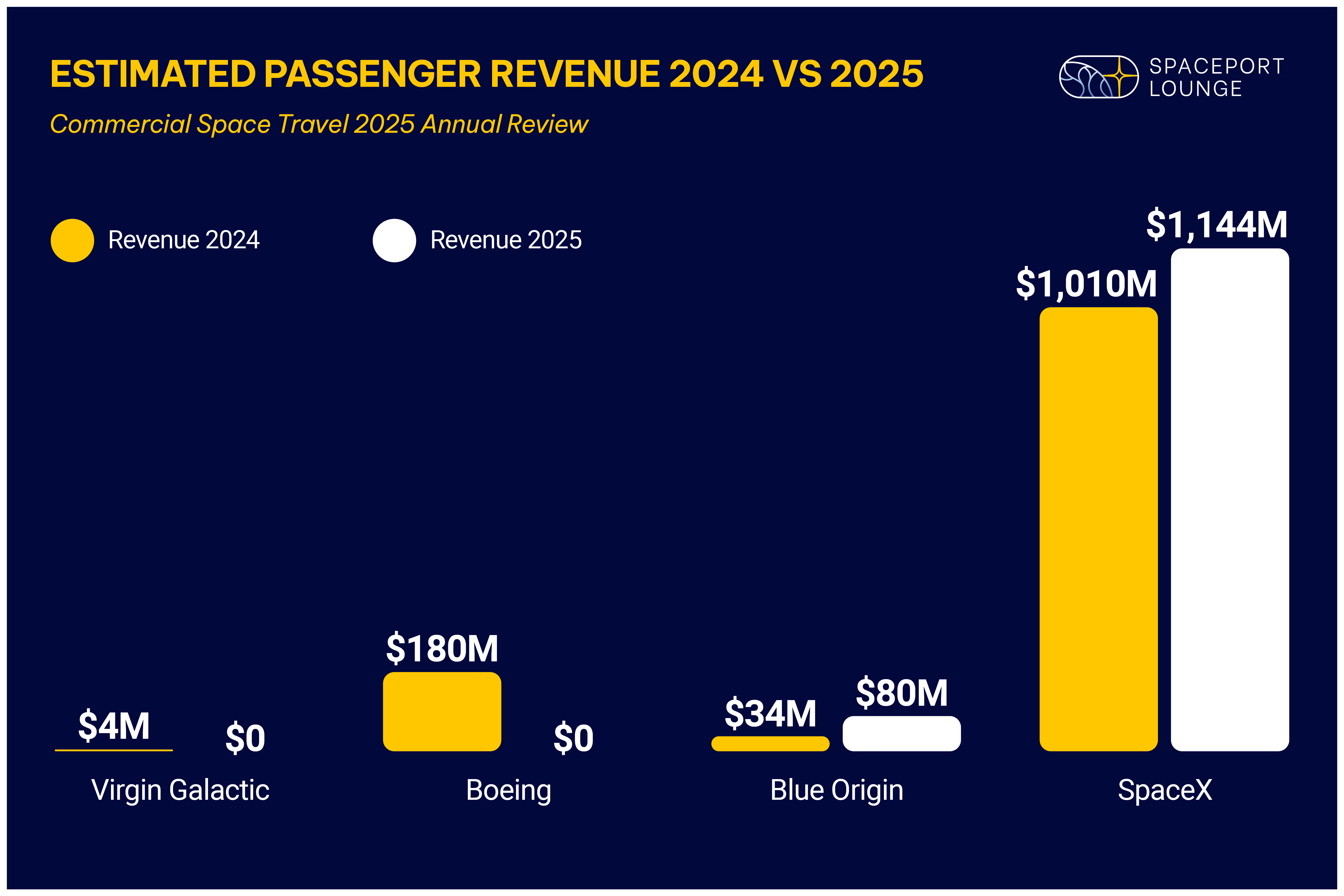
Passenger-derived revenue rose across the sector, led overwhelmingly by SpaceX. Orbital revenue grew moderately on an already large base, reaching an estimated $1.144 billion in 2025. Blue Origin more than doubled suborbital revenue as passenger volume increased, while Boeing and Virgin Galactic dropped to zero following limited activity the prior year.
The revenue split reinforces a central reality of commercial space travel. Orbital missions generate scale and cash flow that suborbital flights cannot yet match, even as suborbital operators carry more passengers. This imbalance is likely a contributing factor to Blue Origin’s decision to shift focus toward orbital and lunar missions moving forward.
Passenger Gender and Age by Company 2025
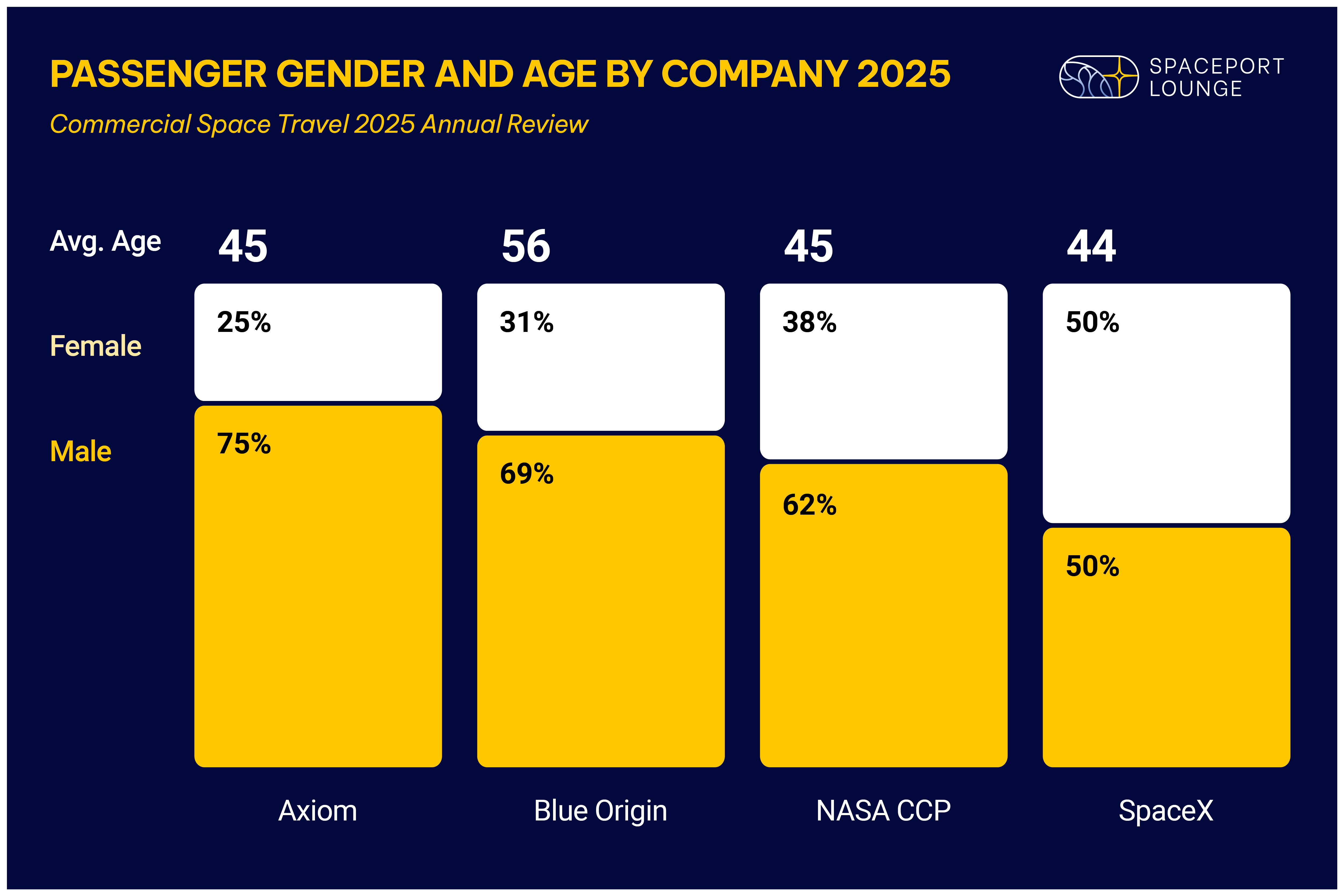
Passenger demographics varied meaningfully by operator and mission profile. SpaceX maintained an even gender split, consistent across missions where it controls crew selection in collaboration with its patrons.
NASA Commercial Crew Program flights reflect steady long-term improvement from an era in which astronauts flying in the 1960s and 1970s were 100 percent male.
Suborbital male concentration reflects a marketplace in which those with the disposable income to purchase an estimated $1.9M seat, likely requiring $100M or greater net worth, are predominantly men, both U.S. and international.
Suborbital flight being mostly a passive activity is reflected in the higher average age of 56. The oldest passenger this year was 85.
Passenger Origin 2025
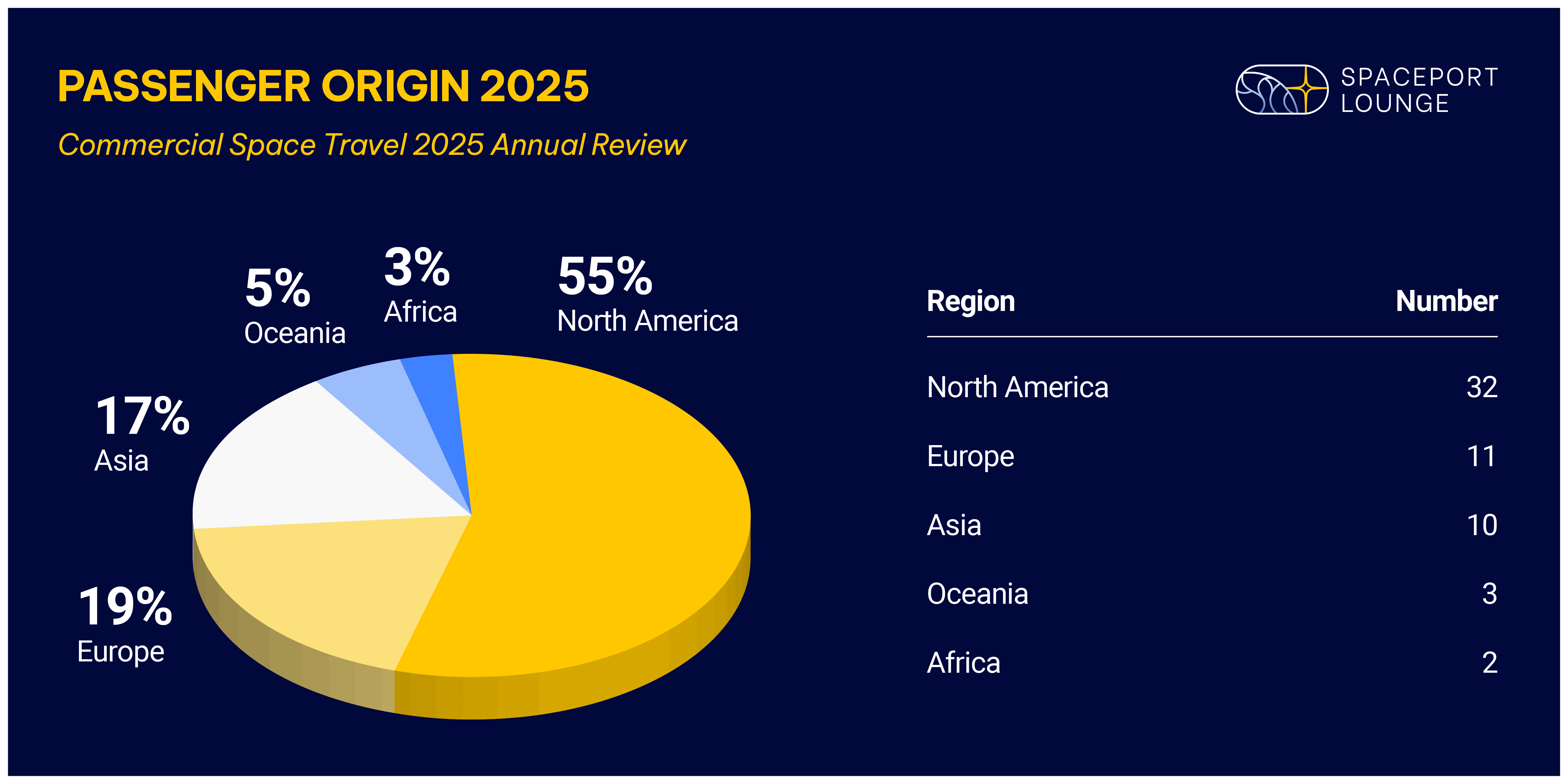
The number of people from around the world increased somewhat, but it is still highly concentrated in North America origin.
Concentration into a few countries of origin will continue to spread across nations as a whole, and across wealthy nations, simply to reflect wealth across the world. Given the infastructure costs of flying passenger rockets, the likely number of spaceliners will remain few, and even reduce, until the cost factor becomes more manageable.
